컨택 센터 내 인공지능 is rapidly reshaping how brands support, delight, and retain their customers. Instead of being seen as a cost to minimize, modern contact centers are becoming strategic growth engines powered by smart automation, data, and human expertise working together.
When implemented thoughtfully, AI solutions for modern call centers do not replace agents. They remove repetitive work, provide real-time insights, and help every agent perform like your best agent on their best day. The result: faster service, more personalized experiences, and a contact center that scales efficiently without sacrificing quality.
Modern organizations rely on cloud computing systems to manage the massive data flows generated by AI in contact centers. These platforms support automation, analytics, and intelligent decision-making, allowing agents to focus on complex customer needs instead of routine tasks. With advanced data processing networks, companies can quickly analyze customer interactions, predict trends, and optimize service delivery for better efficiency.
Marketing teams also gain a competitive edge by integrating insights from AI-driven contact centers into online marketing campaigns. By understanding customer behavior in real time, marketers can design targeted strategies that increase engagement and conversions. Similarly, digital marketing strategies benefit from the synergy between customer service data and promotional efforts, ensuring that messaging resonates with the audience while reducing wasted effort.
From a financial perspective, leveraging AI with business finance insights helps organizations control costs, forecast budgets, and measure ROI effectively. Understanding both operational efficiency and customer satisfaction enables companies to scale without compromising service quality. When AI in contact centers is applied thoughtfully, the combination of technology, marketing, and financial management results in faster resolutions, personalized experiences, and sustainable growth.
Top 10 AI in Contact Center Solutions
AI in contact centers is transforming customer support, helping businesses deliver faster, smarter, and more personalized experiences. Choosing the right platform can impact efficiency, customer satisfaction, and overall business growth. Here’s a look at the top solutions in the market today, starting with Bright Pattern.
1. Bright Pattern
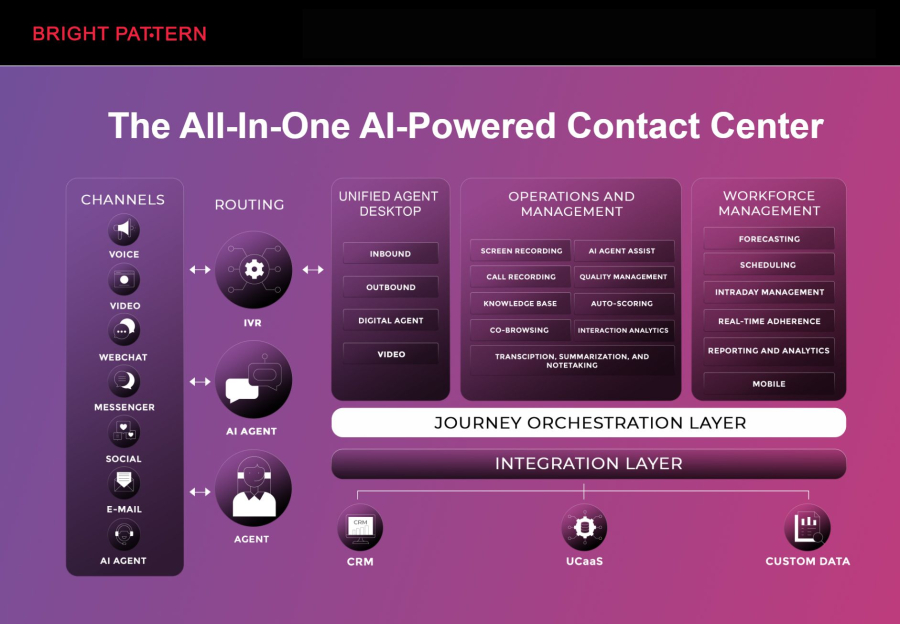
Bright Pattern is a leading AI in contact center platform that enables businesses to streamline interactions, improve agent productivity, and deliver consistent customer experiences across all channels. It integrates smart automation, advanced analytics, and seamless omnichannel support.
Key features include:
- Intelligent call routing to connect customers with the right agent quickly
- AI-powered chatbots for handling repetitive inquiries
- Real-time analytics and agent performance insights
- Omnichannel support across voice, chat, email, and social media
- Easy integration with CRM and third-party business tools
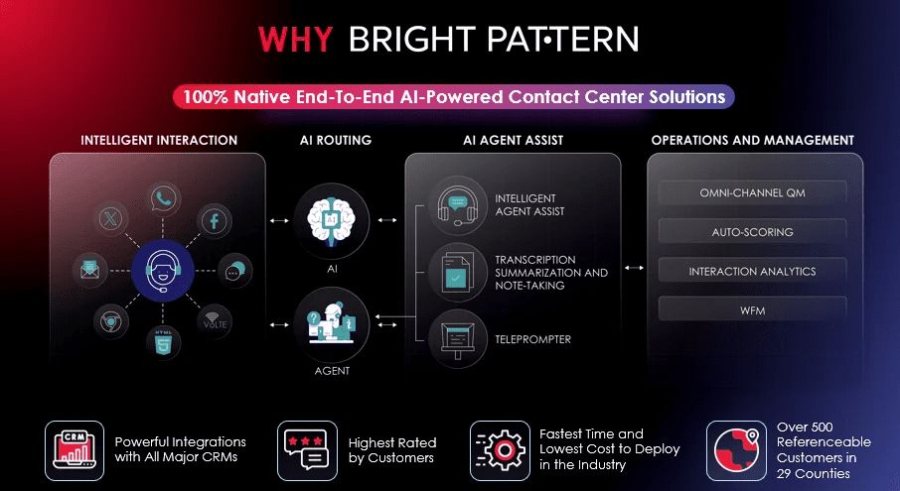
Bright Pattern’s AI in contact center solutions are designed to reduce operational costs while increasing customer satisfaction. Companies can leverage predictive analytics to anticipate customer needs, optimize workflows, and provide agents with real-time guidance. Its flexible architecture ensures scalability for businesses of all sizes, making it a top choice for organizations looking to modernize their customer support.
2. Genesys
Genesys offers AI-driven contact center solutions that enhance customer engagement through predictive routing, sentiment analysis, and intelligent automation.
3. Five9
Five9 provides cloud-based AI in contact center services, including virtual agents, omnichannel routing, and workforce optimization tools.
4. NICE inContact
NICE inContact combines AI, automation, and analytics to help companies deliver personalized customer experiences at scale.
5. RingCentral
RingCentral’s AI solutions enhance call centers by offering smart routing, speech analytics, and automated customer interactions.
6. Talkdesk
Talkdesk leverages AI to improve agent productivity, reduce wait times, and provide actionable insights through advanced reporting.
7. 8x8
8x8 provides cloud contact center software with AI-powered chatbots, real-time analytics, and omnichannel support for efficient customer engagement.
8. Zendesk
Zendesk integrates AI into its customer support platform to automate responses, analyze trends, and assist agents with real-time recommendations.
9. Amazon Connect
Amazon Connect offers AI-enabled contact center services with natural language chatbots, analytics, and seamless integration with other AWS services.
10. Microsoft Dynamics 365 Customer Service
Microsoft Dynamics 365 provides AI-powered insights, automated workflows, and virtual agents to enhance customer engagement and agent productivity.
What Is AI in the Contact Center?
AI in the contact centerrefers to the use of artificial intelligence technologies to automate, augment, and optimize customer interactions across channels such as voice, chat, email, and messaging. It combines machine learning, natural language processing, and analytics to understand customer intent, recommend next steps, and support human agents in real time.
AI can be embedded in many parts of the contact center, including:
- Virtual agents and chatbots that handle routine questions.
- Agent assist tools that surface answers and suggestions during live conversations.
- Intelligent routing systems that match customers to the best resource.
- Speech and text analytics tools that analyze every interaction.
- Workforce management systems that forecast volumes and schedule agents.
Done well, AI becomes a quiet but powerful engine in the background, helping every customer interaction become faster, smarter, and more relevant.
Key Use Cases of AI in Modern Contact Centers
AI can support almost every aspect of contact center operations. Below are the most common and high-impact use cases.
1. Virtual Agents and Chatbots
AI-powered virtual agents can handle a wide range of routine, repeatable inquiries across chat, messaging, and sometimes voice. Typical use cases include:
- Order status and delivery updates.
- Password resets and account access help.
- Billing and balance questions.
- Appointment scheduling or rescheduling.
- Basic troubleshooting and FAQs.
The benefit is twofold: customers receive instant answers 24 / 7, and agents are freed up to focus on complex or sensitive issues that require empathy, negotiation, or deep product knowledge.
2. Agent Assist and Real-Time Guidance
Agent assisttools act like a smart co-pilot for your agents during live calls and chats. Using natural language processing, they can:
- Detect what the customer is asking in real time.
- Surface relevant knowledge base articles or workflows.
- Suggest the next best action or offer.
- Auto-summarize calls and add notes after each interaction.
For new agents, this dramatically shortens ramp time. For experienced agents, it reduces cognitive load and ensures step-by-step consistency, even with complex policies or products.
3. Intelligent Call and Chat Routing
Traditional routing relies on menu options and queue logic. AI-driven routing goes further by analyzing customer data, interaction history, and real-time intent signals to determine where each interaction should go.
AI can help route based on:
- Skill and expertise– matching customers to agents with specific product, language, or compliance skills.
- Customer value– prioritizing high-value customers for faster service or specialized teams.
- Sentiment and complexity– directing upset or complex cases to senior or retention-focused agents.
This improves first contact resolution, reduces transfers, and ensures that precious human time is spent where it has the greatest impact.
4. Speech and Text Analytics
Every contact center holds a goldmine of customer insight in calls, chats, and messages. Historically, only a small sample of these interactions was reviewed manually. AI changes that.
With speech and text analytics, AI can process 100 % of interactions to:
- Identify common reasons for contact.
- Spot product or process issues driving volume.
- Detect sentiment and emotion throughout the conversation.
- Monitor compliance with scripts and regulatory requirements.
- Highlight coaching opportunities for agents.
The result is a constantly updating picture of customer needs and operational performance, based on the actual voice of the customer rather than assumptions.
5. Quality Assurance and Performance Management
Manual quality assurance typically involves supervisors listening to a few calls per agent each month. AI can automate large parts of this process by scoring every interaction against predefined criteria such as greeting, verification, empathy, compliance statements, and resolution.
This enables:
- Fairer, more consistent evaluations across the entire team.
- Faster identification of training needs and best practices.
- Objective performance dashboards for agents and leaders.
Supervisors can then spend more time coaching and less time manually searching for examples to review.
6. Forecasting and Workforce Optimization
AI-driven forecasting models can analyze historical contact volumes, seasonal trends, and external factors to predict future demand more accurately. This supports improved workforce management by helping you:
- Schedule the right number of agents at the right times.
- Reduce costly overstaffing and stressful understaffing.
- Plan for new product launches, marketing campaigns, or policy changes that may drive spikes in contact volume.
Better forecasting means more stable service levels, improved customer experience, and a smoother workload for agents.
Benefits of AI for Customers, Agents, and Business Leaders
AI in the contact center delivers value across the entire ecosystem. Here is how different stakeholders benefit.
Customer Benefits
- Faster response times– Virtual agents and intelligent routing reduce wait times and enable near-instant answers for simple tasks.
- Always-on service– AI-powered self-service offers 24 / 7 support, beyond normal business hours.
- More personalized experiences– AI can leverage past interactions and preferences so customers do not have to repeat the same information.
- Smoother handoffs– When escalation is needed, AI can pass full context from bot to agent, eliminating repetitive questions.
- Higher first contact resolution– Better routing and smarter support increase the likelihood that issues are resolved in a single interaction.
Benefits for Agents and Supervisors
- Less repetitive work– AI handles common, low-complexity tasks, so agents can focus on meaningful, higher-value conversations.
- Reduced cognitive load– Real-time guidance and suggested responses help agents avoid searching multiple systems under pressure.
- Faster training and onboarding– New hires ramp up more quickly with AI-driven prompts, knowledge surfacing, and automated workflows.
- More focused coaching– Analytics highlight specific calls or chats for review, helping supervisors provide targeted, constructive feedback.
- Increased job satisfaction– By spending more time solving complex problems and helping people, agents often find their roles more engaging and rewarding.
Benefits for Business and Operations Leaders
- Lower cost to serve– Automation of routine contacts and improved efficiency reduce overall cost per interaction.
- Improved customer satisfaction and loyalty– Faster, more accurate resolutions drive better experiences and long-term loyalty.
- Data-driven decision making– Speech and text analytics provide a continuous view into customer needs and operational performance.
- Scalable operations– AI allows service levels to be maintained as volumes grow, without scaling headcount at the same rate.
- Stronger compliance– Automated checks help ensure required disclosures and processes are followed more consistently.
Common AI Capabilities in Contact Center Platforms
While every technology stack is different, most AI-enabled contact centers use a combination of the following core capabilities:
|
AI Capability |
What It Does |
Key Benefit |
|
Natural Language Understanding |
Interprets customer intent from voice or text. |
Enables conversational bots and smart routing. |
|
Natural Language Generation |
Creates human-like responses in real time. |
Supports chatbots, suggested replies, and summaries. |
|
Machine Learning Models |
Identify patterns and make predictions based on data. |
Power forecasting, routing, and next-best-action. |
|
Speech Recognition |
Converts spoken language into text. |
Makes calls searchable and analyzable at scale. |
|
Sentiment Analysis |
Estimates customer emotion during interactions. |
Helps prioritize escalations and coach empathy. |
|
Conversational Analytics |
Extracts themes, trends, and risks from interactions. |
Provides continuous insight into customer needs. |
How to Implement AI in Your Contact Center: A Practical Roadmap
Rolling out AI in a contact center does not have to be overwhelming. A phased, results-oriented approach helps you build momentum and demonstrate value quickly.
Step 1: Clarify Your Business Objectives
Before choosing tools or vendors, define the specific outcomes you want to achieve. For example:
- Reduce average handle time while maintaining quality.
- Increase first contact resolution.
- Deflect a portion of routine contacts to self-service.
- Improve customer satisfaction scores.
- Gain better insight into why customers are reaching out.
Clear goals will guide which AI capabilities to prioritize and how to measure success.
Step 2: Assess Your Current Contact Center Data
AI relies on data. Review what you already have across channels, including:
- Historical call recordings and chat transcripts.
- Contact reasons and disposition codes.
- Existing knowledge base content and macros.
- Customer journey data from your CRM or ticketing systems.
The richer and cleaner your data, the more accurate and useful your AI models will be. If data is fragmented or inconsistent, part of your roadmap should include data consolidation and governance improvements.
Step 3: Start with High-Impact, Low-Risk Use Cases
Early wins are crucial to building confidence and support. Consider starting with:
- AI-assisted knowledge search– Helping agents find answers faster, without changing the customer experience immediately.
- Call and chat summarization– Reducing after-contact work and improving documentation.
- Basic virtual agent flows– Handling simple FAQs and routing while leaving complex issues to humans.
These use cases typically deliver measurable benefits without introducing significant risk to customer satisfaction.
Step 4: Involve Agents and Supervisors Early
Agents are the day-to-day experts on customer needs and frontline processes. Involving them early helps you:
- Identify which tasks are best suited for automation.
- Design AI support that fits naturally into their workflows.
- Address concerns about change and clarify how AI benefits their work.
When agents see AI as a helpful partner rather than a threat, adoption and impact rise dramatically.
Step 5: Pilot, Measure, Then Scale
Run limited pilots before full-scale rollouts. During the pilot stage, track metrics such as:
- Average handle time.
- First contact resolution rate.
- Containment rate for virtual agents.
- Customer satisfaction scores.
- Agent productivity and satisfaction indicators.
Use feedback from both customers and agents to fine-tune your AI models and workflows. Once results are stable and positive, expand to more queues, channels, or regions.
Best Practices for Successful AI Adoption in Contact Centers
To get the most from AI, a few guiding principles make a big difference.
1. Keep Humans in the Loop
AI performs best when combined with human judgment. Maintain clear paths for customers to reach a live agent whenever needed, and ensure agents can override AI suggestions when they see better options.
2. Design with the Customer Journey in Mind
AI should streamline the customer journey, not add friction. Map out typical paths customers take and ensure that virtual agents, routing, and agent assist tools work together to create a smooth, coherent experience from start to finish.
3. Prioritize Transparency and Trust
Be open with customers when they are interacting with a virtual agent, and make it easy to request a human. Internally, communicate clearly with staff about what AI is doing, what data it uses, and how decisions are made. This promotes trust and responsible usage.
4. Continuously Train and Improve Your Models
Customer language, products, and processes evolve. AI models need regular updating with fresh data, feedback, and new edge cases. Set up a cycle of monitoring, retraining, and optimization rather than treating AI as a one-time project.
5. Focus on High-Quality Knowledge and Processes
AI amplifies the quality of the knowledge and workflows it is built on. Invest in:
- Clear, accurate, and up-to-date knowledge base content.
- Well-documented processes for common contact types.
- Consistent tagging and categorization of contact reasons.
Better inputs lead directly to better AI outputs.
6. Align AI Metrics with Business Outcomes
Avoid focusing only on technical metrics such as model accuracy. Tie AI performance to business and customer outcomes, including:
- Customer satisfaction and loyalty indicators.
- Cost per contact and overall efficiency.
- Agent retention, performance, and engagement.
- Revenue impact from better retention or cross-sell and upsell.
This ensures that AI investments stay grounded in real, measurable value.
Future Trends: Where AI in Contact Centers Is Heading
AI in contact centers is still evolving quickly. Several trends are shaping the next wave of innovation.
More Natural, Human-Like Conversations
Advances in conversational AI are making virtual agents more capable of handling multi-step, nuanced interactions. Over time, customers will experience smoother, more natural conversations with bots, especially for clearly defined tasks.
Deeper Personalization
AI will increasingly draw from a broader range of data sources, including past purchases, browsing behavior, and previous support interactions, to tailor each conversation. This can lead to more relevant recommendations, proactive outreach, and customized solutions.
Proactive and Predictive Service
Rather than reacting only when customers reach out, AI will help organizations anticipate issues and address them early. For example, AI can flag patterns that suggest a product issue or billing confusion, prompting proactive communication and support.
Tighter Integration Across the Customer Journey
Contact center AI will increasingly connect with marketing, sales, and product systems. This creates a more unified view of the customer and ensures that insights from support interactions inform decisions across the business.
Frequently Asked Questions About AI in Contact Centers
Does AI replace human agents?
In most modern implementations, AI is designed toaugmenthuman agents, not replace them. It handles routine tasks, surfaces information, and automates after-contact work, while humans manage complex, sensitive, or highly personalized interactions. Over time, this usually results in richer roles for agents, not fewer opportunities.
Is AI only for large contact centers?
No. While large centers may have more complex use cases, many AI capabilities scale down effectively. Smaller teams can benefit from virtual agents for basic inquiries, AI-assisted knowledge search, and call summarization without needing massive infrastructure. Cloud-based solutions and modular tools have made AI more accessible to organizations of all sizes.
How long does it take to see results?
Timelines vary based on scope and complexity, but many organizations see early wins within a few weeks to a few months by focusing on specific, well-defined use cases. For example, implementing AI-based summarization or a limited-scope chatbot often delivers noticeable gains relatively quickly. Broader transformation programs naturally take longer and evolve in phases.
What about data privacy and compliance?
Responsible AI use in contact centers includes strict attention to privacy, security, and regulatory requirements. This typically involves robust access controls, encryption, data retention policies, and careful handling of sensitive information. When planning AI initiatives, it is important to involve legal, compliance, and security teams early to ensure that solutions meet applicable standards and regulations.
Turning Your Contact Center into a Strategic Asset with AI
AI in the contact center is not just a technology upgrade. It is a powerful way to rethink how you serve customers, empower employees, and drive business outcomes. By combining the strengths of intelligent automation with human empathy and expertise, you can create a support experience that is faster, more consistent, and more personalized than ever before.
Whether you are just beginning with basic chatbots or exploring advanced analytics and real-time agent assist, each step toward AI-enabled operations moves your contact center closer to being a true competitive advantage. The organizations that thrive will be those that embrace AI thoughtfully, keep humans at the center, and continuously learn from every conversation.
